
akademie der autodidakten
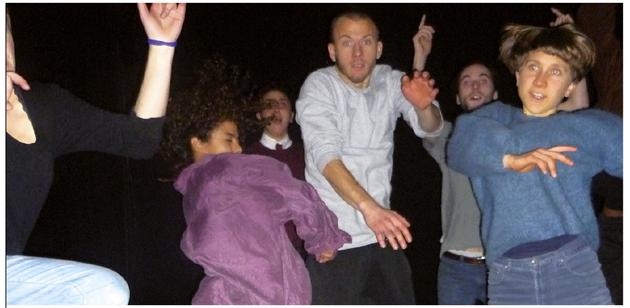
Are there correlations between symbols of the Black Power Movement and Sign Language? Or forms of racism in language which were transferred to the signs? Does the colour of skin matter to blind people? How unfamiliar are we to one another? How can we connect to one another? These are the kind of questions that arose at the beginning of the performance Decolonize Bodies! Minds! Perceptions! ‒ an akademie der autodidakten project at Ballhaus Naunynstraße involving deaf, seeing, blind and hearing youth working together.
Decolonize brings together deaf and hearing people, signing and phonetic speakers, blind and seeing people. Collectively they set out for perceived boundaries in order to find out what they will meet there. Using silence, light, darkness, sounds and physical expression, they allow for the stage curtain to rise in their own minds.
The point of departure for the creative work are the different experiences of the participants developing the performance in a collaborative process. At the same time, the creative process is also a space for concentration, mobility, misunderstandings, translation and differences. Experiences are translated into sounds, videos, body and sign language, poetry, improvisations and speeches.
Our perception is still informed by colonial value systems. We want to address the barriers this system creates. Experiences of openness and inadequacy, of inclusion and exclusion also inscribe themselves into our bodies. They shape our posture, concentration, and movement and become part of our behaviours. Bodies carry meanings and possibilities. The body is the reference incorporating our ethnic, gender and sexual identities and differences.
Language and perceptions of people, the production of images, and media representations are the source of identification, reproduction and the self-evaluation this creates. Decolonize Bodies! Minds! Perceptions! examines these mechanisms and juxtaposes the self-determined performance of the protagonists in opposition to the social production of consciousness.
How do our perception, our communication, our action and our view of ourselves change when we no longer only talk about inclusion but actually put it into practice? What is in store for people when they overcome their barriers, when they decolonise their consciousness? Decolonize sets out to find contradictions, commonalities and differences.
Essential elements of the activities will be translations of the participants’ diverse mother tongues, transfers from phonetic to sign language and back, poetisations of audio descriptions and their retranslation into actions and signs.
The movement between the various semiotic systems and their idiosyncrasies offers the possibility of creating new meanings and contexts.
Connecting different cultures of perception and communication changes our mindscape. Bodies make songs audible for deaf people, they create sounds through rhythmic movement and the sound creates images in the mind. New imaginations emerge and need to be comprehended. They are put into question and negotiated in many and varied ways. The negotiation changes events.
Decolonize brings the protagonists into an interaction of communication in an inclusive world.